13th International Drying Symposium (IDS2002)
Beijing, P.R. China
August 27-30, 2002
CONFERENCE REPORT
The 13th International Drying Symposium was being held in
the beautiful Chinese capital city of Beijing, China during August 27-30,
2002; this was the second time the symposium was hosted by an Asian country
(the first IDS held in Asia was IDS84 in Kyoto, Japan). The symposium
welcomed 296 participants (from 42 counties) from almost all parts of the
world viz. Africa, Asia, Australia and New Zealand, Europe, North, Central
and South Americas. This again made the symposium a truly international
forum for the exchange and dissemination of ideas related to the science
and engineering of drying - a tradition that has continued for the past 24
years since its inception by Professor A.S. Mujumdar at McGill University
in Montreal, Canada in 1978.
A total of 236 papers (8 keynotes and 228 contributed papers) written by
546 authors from 43 countries appear in the elegantly produced 3-volume
hardcover set of proceedings (which can be purchased by writing to the
address given at the end of this report). As is seen in Figure 1 the
contribution to the technical program of the host was the greatest, which
is expected; this trend was true as well for all but the last IDS (IDS2000
where France took the lead rather than the host, the Netherlands). Brazil
and Japan, as usual, contributed a large portion to the pool. Thailand also
emerged as a bigger contributor at this IDS, probably due to its closer
traveling distance from China. The contribution of France, however, was not
as strong as the in the past several IDS's.
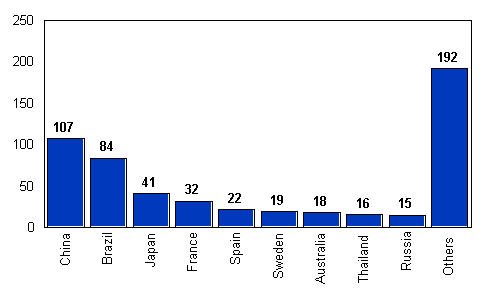
Figure 1. Distribution of authors of IDS2002 papers by their country of
origin
Looking at the distribution of authors by their continent of
origin (Figure 2) may indicate the belief that the interest in drying
research is declining in North America while it is still well maintained in
Asia and Europe. However, the 9/11 effect has probably affected North
America and Western Europe more than elsewhere, which can bias the
statistics. So, care must be taken in drawing any definitive conclusions.
The contributions from South American countries were also quite high
despite the long distance and the high cost of travel from the conference
venue. The rising interest in drying research of the African countries was
also noticed at this IDS.
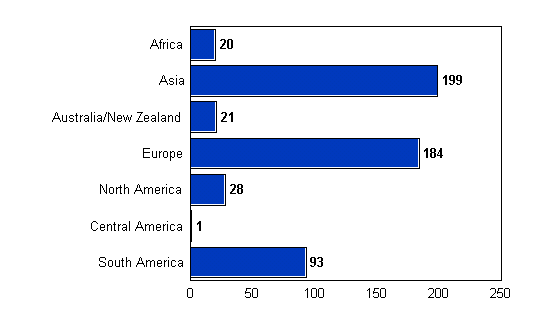
Figure 2. Distribution of authors of IDS2002 papers by their continent of
origin
A total of 329 abstracts were submitted to the Conference
Secretariat while 240 manuscripts were received and 236 of them were
accepted and appear in the proceedings.
Eight keynote lectures were given at IDS2002 by internationally
recognized experts in drying. Prof. Arun S. Mujumdar, the founder of the
IDS series, of the National University of Singapore and McGill University,
Canada, gave a plenary lecture on the research and development in drying
and its future trends. He emphasized the need for the university-industry
interaction in nurturing the drying research and development - the idea
that has also been echoed by a lot of participants even before the end of
the symposium! Another 7 keynote papers cover the topics ranging from spray
drying, polymer drying, food drying, paper drying to the modeling and
simulation of drying processes, recent developments in heat and mass
transfer of single droplets and the review of drying R&D in China.
Figure 3 shows the distribution of IDS2002 papers by their themes.
Among the 228 contributed papers, 160 were presented orally while the rest
were presented in poster sessions. This lengthened the overall duration of
the IDS by a full day compared with previous IDS meetings.
It can be seen in Figure 3, considering the interest of the host
country and its neighbors, that the number of papers devoted to drying of
food and agricultural products is the highest. This trend has indeed
started to hold since the past several IDS's (Coumans, 1997; Pakowski,
1999). Papers on osmotic dehydration were again so numerous that a separate
session was devoted to it aside from sessions on food and agricultural
products drying. The share of papers devoted to fundamentals and modeling
of drying/dryers and that concerning with various types of dryers (fluid
bed, spouted bed, spray, freeze, flash & impinging streams, and
microwave dryers) were equal in number; similar statistics were again
observed during the past several IDS's.
Twenty five percent of all papers appearing in the proceedings
were written by industrial authors or co-authors; the level of the
desirable university-industry interaction was still quite low. Of all
papers, about 16% were joint efforts of authors from different countries. A
higher level of an international collaboration on drying R&D is still
possible although this number is already quite impressive! This is clearly
an indicator of the globalization of R&D.
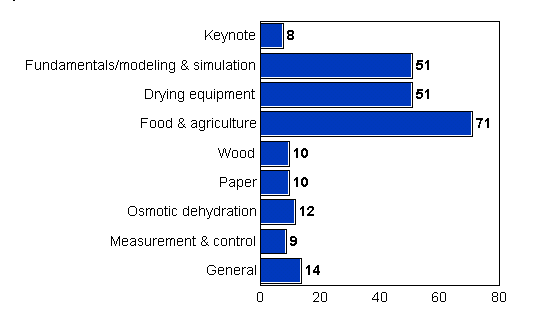
Figure 3. Distribution of IDS2002 papers by their topics
Despite some minor inconveniences, e.g., incorrect organization of
papers into their sessions, IDS2002 was definitely a success. All members
of the organizing committee must be congratulated for their success, which,
of course, was due to their efforts both before and during the conference.
At the end I would like to express my sincere appreciation to
Profs. C.W. Cao and C. Strumillo for supplying me with numbers and
statistics belong to IDS2002. Thanks are also due to Ms. Rungtip
Tapaneyasin of Food Eng., KMUTT for her assistance in compiling data from
the IDS2002 proceedings.
Sakamon Devahastin
Department of Food Engineering
King Mongkut's University of Technology Thonburi
Bangkok, Thailand
REFERENCES
Coumans, W.J., 1997, Some Impression from IDS'96, Drying Technology -
An International Journal, 15(3&4), pp. 1243-1250.
Pakowski, Z., 1999, Impression of IDS'98 as IDS Completes 20 Years,
Drying Technology - An International Journal, 17(6), pp. 1247-
1253.
The 3 volumes of IDS2002 proceedings can be purchased by sending your
name, address and money order (US$120 for sea mail, US$180 for air mail and
US$210 for express mail) to:
Beijing University of Chemical Technology
P.O. Box 100
Beijing 100029, P.R. China
|
